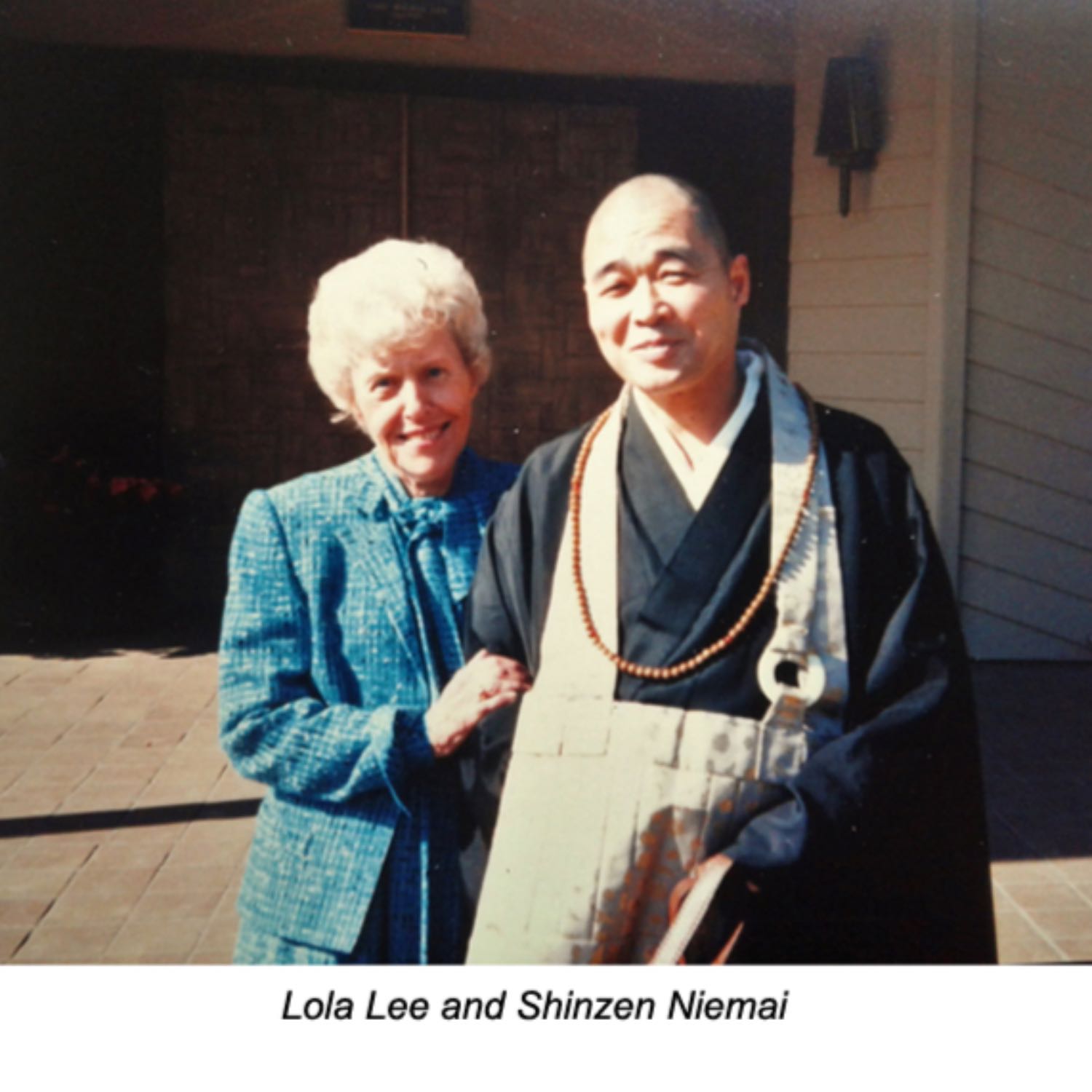
Talks by Zen Roshi, Lola McDowell Lee
By: I & A Publishing
Language: en
Categories: Education, Self Improvement, Religion, Spirituality, Buddhism
This is a series of newly digitized talks by spiritual teacher, Lola McDowell Lee, spanning two decades—from the early Seventies through the Nineties.Lola was a Zen Roshi whose Rinzai lineage included Doctor Henry Platov and renowned Zen master, Shigetsu Sasaki. Lola was a religious scholar as well as an ordained Christian minister.While the talks are focused mainly on Zen and Buddhism, Lola drew on many spiritual traditions—including those of Jesus, Plato, Lao-Tzu, the Hindu Vedas, Meister Eckhart and Gurdjieff.If you find Lola’s talks valuable, more will be posted in days to come. RSSVERIFY
Episodes
Plato, art and spiritual growth. Sep 5, 1987
Dec 14, 2025Zen Roshi, Lola McDowell Lee, explores the concept of freedom through the conquest of self.
Per the Dhammapada, we should direct straying thoughts. The path to happiness is through quieting these elusive thoughts with single-mindedness, which brings freedom.
We struggle from confusing wants and needs and forgetting the primary goal: freedom.
This freedom is not worldly (economic, political, or social). It’s freedom from the ego. When the ego drops, it’s like a curtain falling, revealing the reality. This is the noumenal world described by philosopher Immanuel Kant.
We are caug...
Duration: 01:00:40The Middle Way—between the world of appearance and the inner world of consciousness. Aug 29, 1987
Dec 08, 2025Zen Roshi, Lola McDowell Lee draws on the Dhammapada to emphasize a core principle of spiritual success: vigilance, or watching. The fool is careless and enslaved by desire. The master has firm resolve.
Man is the only creature on Earth with the ability to choose. Unlike animals and plants, whose lives are determined by nature, humans possess a mind that allows for conscious choice.
Man is not born a true being but a becoming. He is a state of perpetual movement between opposing attitudes and emotional states. This becoming is marked by a continual search...
Duration: 01:01:25How do you go in? Simply stop going out. Aug 2, 1987
Nov 29, 2025Zen Roshi, Lola McDowell Lee, continues her discussion of the Dhammapada.
She warns us against mistaking the false for the true, urging us to look into our hearts and follow our true natures. Spiritual texts are meaningless without direct action.
Lola discusses the seeming conflict of seeking external rewards while professing detachment from the fruit of action.
Truth simply is. It is the truth of being, which human effort must uncover. Our chief obstacle is the web of conditioning. To find truth, one must deliberately extract oneself from this accidental conditioning of our...
Duration: 00:59:56The meanings of various Buddhist terms, practices & traditions. July 26, 1987
Nov 23, 2025Zen Roshi, Lola McDowell Lee, explores the meaning of the Dhammapada -Twin Verses.
She discusses the importance of thought and self-mastery in shaping one's experience. We are what we think. All that we are arises with our thoughts. With our thoughts we make the world.
An impure, conditioned mind leads to suffering, while a pure, unconditioned mind leads to unshakable happiness. We have, over and over, a choice of conduct: the easy path of catering to personal ego desires, or the difficult path of conscious transformation.
The negative path is effortless and offers...
Duration: 00:59:57Dogen: “Not knowing is most intimate.” July 5, 1987
Nov 14, 2025Zen Roshi, Lola McDowell Lee, explains the story of Dogen Zenji, the founder of the Soto Zen school in Japan. One master says, “Not knowing is most intimate.”
Dogen’s question: if we are already Buddha nature — if enlightenment is our essence — then why do we need to seek it?
When Dogen returned to Japan, he founded the Soto school and taught Shikantaza — just sitting. This practice, Lola explains, is single-minded meditation without striving or grasping — simply allowing truth to reveal itself.
Meditation, explains Lola, is about resting in awareness, with nothing held back. The natu...
Duration: 01:00:09How you form your ego—and can ultimately overcome it. Jun 28, 1987
Nov 02, 2025Zen Roshi, Lola McDowell Lee, tells a parable about a powerful Chinese prime minister, who was a devoted Zen student. When the minister asked his master, "how does Zen explain egotism?" the master insulted him, calling him a "numbskull". As the minister's face filled with anger and hurt feelings, the master smiled and said, "Your Excellency, this is ego".
Lola explains that this ego is our very basic problem. Paradoxically, we need It presents we need the ego to function in the world, yet it is also our biggest stumbling block to discovering our true identity.
<... Duration: 00:57:05Zen and Socrates. Jun 21, 1987
Oct 20, 2025Zen Roshi, Lola McDowell Lee, argues that most people waste their lives playing superficial games and are deceived by their own minds. They fail to engage in the urgent, life and death work of knowing themselves. The pursuit of money, power, prestige, and reputation are hollow endeavors, like waves on an ocean.
Lola draws parallels between Zen practice and the Socratic method.
Many of us meditate for a short period only to ignore one’s inner awareness for the other 23 hours of the day.
Lola describes Greek philosopher Socrates as a figure who ma...
Duration: 00:58:34Instructions for Koan study. And true understanding & non-discrimination. May 31, 1987
Oct 14, 2025Zen Roshi, Lola McDowell Lee, recounts the story of master Joshu who offers cups of tea to the various monks, illustrating the idea of how distinction keeps us from seeing the world as it is. When he offers the same tea to newcomers and long-time members alike, the manager asks why. And Joshu has a shouting response. Why?
Our scientific world breaks the world into bits, opreating within a framework of complexity and duality because seeing the simplicity of the whole is so difficult for us to grasp.
Zen teaches us the value of non-discrimination—th...
Duration: 00:53:10Instructions for Koan study. And true understanding & non-discrimination. May 31, 1987
Oct 13, 2025Zen Roshi, Lola McDowell Lee, recounts the story of master Joshu who offers cups of tea to the various monks, illustrating the idea of how distinction keeps us from seeing the world as it is. When he offers the same tea to newcomers and long-time members alike, the manager asks why. And Joshu has a shouting response. Why?
Our scientific world breaks the world into bits, opreating within a framework of complexity and duality because seeing the simplicity of the whole is so difficult for us to grasp.
Zen teaches us the value of non-discrimination—th...
Duration: 00:53:10The limitations of human knowledge. May 17, 1987
Oct 08, 2025Zen Roshi, Lola McDowell Lee, discusses human knowledge an its limitations.
Typical knowledge is the result of fragmented perception. Our knowledge is narrow, limited to appearances and governed by desire, habit, and subconscious impulses.
The relationship of Surya (divine light) and Agni (divine force).
Agni symbolizes will in consciousness. Together, Surya (knowing) and Agni (will) form a unity. Knowledge and Will are not separate. They are two aspects of the same foundation of reality.
The Upanishads say that sin is not moral condemnation but that which causes a deviation from the...
Duration: 01:03:13In the struggle between opposites is the Truth. Mar 6, 1987
Sep 26, 2025Zen Roshi, Lola McDowell Lee, draws on Buddhist and Hindu traditions (including the Mahabharata, Ramayana and Bhagavad Gita) to explain the human condition.
Struggles and opposition are partners in our growth. Manjushri (wisdom) is not found in shrines, but is alive within each person.
Lola recounts a tale of a monk and the village courtesan.
She talks about how struggle is necessary for growth; it develops character. Friend and foe, like rose and thorn, are inseparable opposites. The human tendency is to focus on one side and ignore the other. True vision includes...
Duration: 00:59:56Where is God? Feb 28, 1987
Sep 11, 2025Note: Generally, this talk is more lighthearted than most that Lola gives. It’s nice to see that side of her personality.
Lola begins with a comical tale about a man and a priest he asks for advice.
Zen Roshi, Lola McDowell Lee, discusses Lao Tzu concept of how the hole in the wheel’s knave makes its utility. How the emptiness of a vessel creates its utility.
Lola asks, “Who would you rather be: a victim or a perpetrator?”
It is in the world of the Relative that we can discover...
Duration: 01:01:06Mystica Theologica, the Sutras of Patanjali and the Book of Genesis. Jan 31, 1987
Aug 31, 2025Zen Roshi, Lola McDowell Lee, discusses various texts about the notion of God — from the biblical book of Genesis to Mystica Theologica to the sutras of Patanjali.
Dionysus was a disciple of St. Paul and one-time mayor of Athens.
We eat from the Tree of Knowledge of Good and Evil… but we must return to the Tree of Life.
Buddhism did not identify God. Or a self. So for a Buddhist, what is there? Perhaps a Buddhist might say there is a Power greater than himself.
Why did God create the worl...
Duration: 00:58:07How do you answer: “Does God exist?” Sep 20, 1987
Aug 24, 2025Zen Roshi, Lola McDowell Lee, (who is also an ordained Christian minister) explores issues that are common to both Christian and Eastern thought to illustrate the difference between theology/philosophy and religious practice.
She explains that it is easier to join a religious group and hang around it than it is to truly struggle with oneself. There are many who participate in religions just so they can tell themselves they are doing their religious duty. They learn a religious system or structure and think they have learned some truth. Not so.
Simply wishing will not...
Duration: 00:59:35A detailed introductory talk about the Bauls — a religious sect of India—and the mystery of consciousness. Sep 13, 1987
Aug 10, 2025Note: Unfortunately these talks about the Bauls were posted out of order. But the sound quality is much better on this one, which is also the most detailed in its explanation of who the Bauls were. And this talk develops into a wonderful, rich discussion of consciousness.
Lola says that not many people have heard of the Bauls because they had no organization or dogma or scripture. They were freewheeling practitioners who loved dance, music and poetry—and looked within.
Zen Roshi, Lola McDowell Lee, explains how the Indian Bauls were a group of Hindus al...
Duration: 00:59:31The Bauls religious sect of India. And Prakrit and Parusha. Oct 18, 1987
Aug 04, 2025Note: this talk has some sound issues, but I found it valuable enough to include the bulk of it anyway. It’s about 8 minutes shorter because the cassette player apparently started warbling and slowing down badly at the end—during the discussion of Prakrit and Parusha. There is another talk on this subject available here if you are interested. It’s a fascinating doctrine.
Zen Roshi, Lola McDowell Lee, explores the accounts of the Indian Bauls - a religious group that included members of Vaishnava Hindus and Sufi Muslims.
They had a freewheeling spirit. And worshi...
Duration: 00:41:44Zen and the meaning of Easter. Apr 19, 1987
Jul 28, 2025Zen Roshi, Lola McDowell Lee, gives a talk themed on Easter. (While Lola was primarily a Zen teacher, she was also an ordained Christian minister).
Lola reads from the Gospels exploring the meaning of Jesus asking, “Why have you forsaken me?”
Symbols of Easter include a baby chick, pecking its way out of an egg to become that which he was destined to be. That is also a good metaphor for the human situation.
Lola discusses various religious traditions, including that of the Mayans of Central America and Jewish Mysticism.
Nothing is t...
Duration: 01:00:00Guilt and rejection of life does not make you more enlightened. Lola May , 1987
Jul 23, 2025Zen Roshi, Lola McDowell Lee, explores the meaning of Verse 15 of the Isha Upanishad:
"The face of Truth is covered with a brilliant golden lid; that do thou remove, O Fosterer, for the law of the Truth, for sight."
Lola discusses the prevalence of guilt in Puritanical America. How some of us feel guilt our entire lives, and how many, sometimes because of religious traditions, feel they shouldn’t enjoy life. We should look at this guilt, and try to understand it.
Meditation should not be an escape mechanism.
Buddha taught th...
Duration: 01:00:00What we can learn from Indian religious traditions. May 10, 1987
Jul 07, 2025Zen Roshi, Lola McDowell Lee, gives a detailed discussion of the philosophical and historical backgrounds of religious traditions as they developed in India—Vedas, Brahmanism and Hinduism.
Lola explains the meaning of many of the Hindu terms and explores the Isha Upanishad.
Shakti, the Great Mother or feminine energy of the universe. We all have in us a power. That is shake.
Hindu Tantra versus Buddhist Tantra.
Prakriti and Purusha.
Maya.
As mentioned in the Bible, your actions in this world show your faith.
A me...
Duration: 00:59:20How to meditate. And why. Nov 29, 1987
Jun 28, 2025(Note: original recording audio is not ideal, but Lola's message is great)
Zen Roshi, Lola McDowell Lee, gives an ind-depth explanation of the practice of sitting, as this talk is during a sesshin at the temple.
Who is the Buddha? What is birth and death?
Zazen is learning about life by dying to one’s self. Be quietly alert, dropping the ego and identifications.
Our mistake is taking the phenomenal to be the noumenal. But they are really two aspects of the same thing.
Emotions confuse us and cause us...
Duration: 00:53:02The unconscious is the gateway to reality. July 18, 1981
Jun 20, 2025Zen Roshi, Lola McDowell Lee, discusses the meaning of the Zen saying, “Joy in the morning. Sleep at night. What else?”
When we “do not know,” then we don’t concern ourselves with obsessions about outcomes. That is the meaning of “no mind.”
Start by discovering what “no mind” is not.
Is there a gradual acquisition of “no mind?”
Is there an enduring entity called self? Is there a self to improve? Do not accept of reject an answer without learning for yourself directly.
Is the thinker different than his thoughts?
Ju...
Duration: 01:01:01Why “What is the purpose of life?” is the wrong question. June 28, 1981
Jun 02, 2025Zen Roshi, Lola McDowell Lee, discusses Chapter 10 from the Tao Te Ching (Paul Carus translation)
"What can be done?
"Who by unending discipline of the senses embraces unity cannot be disintegrated. By concentrating his vitality and inducing tenderness he can become like a little child. By purifying, by cleansing and profound intuition he can be free from faults.
"Who loves the people when administering the country will practice nonassertion.
"Opening and closing the gates of heaven, he will be like a mother-bird; bright, and white, and penetrating the four quarters, he...
Duration: 00:56:00The role of patience in Zen practice. July 5, 1981
May 28, 2025Zen Roshi, Lola McDowell Lee, explores the notion of patience in practice. And time.
For nearly twenty years, Hon, a layman, studied under Master Egon. Several of the students went out to the edge of the district and Hon looked up at the falling snow and said, “Snowflakes as nice as these do not fall elsewhere.”
We are all in such a hurry. But time is a state of mind—full of anxiety about the future and the past. If you are patient enough, you will not miss yourself. The Buddha sat and sat and sat… i...
Duration: 00:53:02Further exploration of the Mystica Theoligica. Dec 11, 1988
May 18, 2025Zen Roshi, Lola McDowell Lee, further explores the Mystica Theoligica.
NOTE: LOLA HAS A BAD COLD TODAY AND A PERSISTENT COUGH. If that bothers you, please skip. But the content of the talk is worth the discomfort, in my opinion.
Religious life is like a sculpture… best to take away from life that which is not Him rather than ascribe characteristics to Him.
Most of our thoughts and emotions are unconscious. And people think: Oh, how life without emotions and desire would be so colorless. But is that true?
Heraclitus preferred wh...
Duration: 00:53:53The meaning of the the Mystica Theoligica. Dec 4, 1988
May 10, 2025Zen Roshi, Lola McDowell Lee, explores the meaning of the opening of the Mystica Theoligica.
“Thou Trinity beyond Being, direct us to the heights of mystical revelation, sublime beyond all thought and light, wherein the simple, absolute and immutable mysteries of Divine Truth are hidden in the translucent darkness of that silence which revealeth in secret. For this darkness, though of deepest obscurity, is yet radiantly clear, and though beyond touch and sight, it overfills our unseeing mind with splendors of transcendent beauty. This is my prayer….”
Lola does a deep dive into the meaning of the...
Duration: 01:00:19Watch how you make your choices. Otherwise, how can you ever change? Nov 6, 1988
May 05, 2025Zen Roshi, Lola McDowell Lee, recounts the tale of the Persian teacher who asked a disciple to place a bag of gold in the middle of a bridge. He is to find a poor man to cross the bridge. The man successfully crossed the bridge where there is a bag of gold which he desperately needs. But he missed the gold. He had been too afraid to open his eyes and never saw it.
Our problem is we think know our faults. But we close our eyes to them.
You seekers who want freedom… freedom fr...
Duration: 00:57:06How often do we think that we—as individuals—are going to be enlightened? Oct 30, 1988
Apr 28, 2025Zen Roshi, Lola McDowell Lee, shares the tale of a student who asked his teacher why, after he had fasted and prayed for 30 years that he had still not found God. The teacher’s response: “You could sit for 100 years and it wouldn’t do any good. Selfishness is your barrier.”
Lola recounts a long letter to a Roshi where the practitioner listed all his thoughts about spirituality and the universe. The Roshi’s response: “You know too much.” Just accumulating words is not gonna do it.
If you acknowledge that you don’t know… then you can live...
Duration: 00:48:01Meditate for one hour daily, and truly concentrate, and you can merge with the Ku. July 31, 1988
Apr 21, 2025Zen Roshi, Lola McDowell Lee, continues her examination of Lao Tsu’s Tao Te Ching, now in Chapter 17.
"The great rulers - the people do not notice their existence;
The lesser ones - they attach to and praise them;
The still lesser ones - they fear them;
The still lesser ones - they despise them;
For where faith is lacking,
It cannot be met by faith.
Now how much importance must be attached to words!"
- Translated by Ch'u Ta-Kao
In to...
Duration: 01:00:08The One-finger Zen of 9th Century Chinese Master Gutei. Jul 10, 1988
Apr 13, 2025Zen Roshi, Lola McDowell Lee, goes into considerable detail early and late in the talk about meditation to help prepare students for a sesshin.
Lola talks about how the subject and object become one. One sitting.
Master Gutei and his One-finger Zen.
Lola discusses various teachings involving the monastery’s Tenzo, or cook. And why this is a very advanced position within the system.
She recounts the tale of Dogen Zenji and the cook, and why the cook couldn’t continue his conversation with the master and needed to return to his...
Duration: 00:56:15To meditate no action is required—simply a shift in consciousness. Exploring the Tao Te Ching, Chapter 16. Jul 3, 1988
Apr 06, 2025Zen Roshi, Lola McDowell Lee, continues a discussion of Lao Tsu’s Tao Te Ching. Today, Chapter 16 (Suzuki translation)
By attaining the height of abstraction we gain fulness of rest.
All the ten thousand things arise
And I see them return.
Now they bloom in bloom
But each one homeward returneth to its root.
Returning to the root means rest.
It signifies the return according to destiny.
Return according to destiny means the eternal.
Knowing the eternal means enlightenment.
No...
Duration: 00:52:13How do we cross an icy stream? Exploring the Tao Te Ching, Chapter 15. May 28, 1988
Apr 02, 2025Zen Roshi, Lola McDowell Lee, continues her exploration of the Tao Te Ching. Today, Chapter 15:
The ancient masters were subtle, mysterious, profound, responsive.
The depth of their knowledge is unfathomable.
Because it is unfathomable,
All we can do is describe their appearance.
Watchful, like men crossing a winter stream.
Alert, like men aware of danger.
Courteous, like visiting guests.
Yielding, like ice about to melt.
Simple, like uncarved blocks of wood.
Hollow, like caves.
Opaque, like muddy...
Duration: 01:00:30A detailed exploration of Chapter 14 of Lao Tzu’s Tao Te Ching, “Praising The Mysterious.” May 8, 1988
Mar 28, 2025Zen Roshi, Lola McDowell Lee, provides a detailed exploration of Chapter 14 of Lao Tzu’s Tao Te Ching, “Praising The Mysterious.” In it Lao Tzu calls Reason the form of the formless. Reason’s clue.
But if we can’t touch it or see it, how are we to understand it? Don’t to endow it with qualities. Don’t describe it. It may appear bright, but it is simply reflecting our brightness. But that is only what we perceive. It is, itself, not bright.
Our perception is limited. We perceive in twos. But the Tao is one. So...
Duration: 00:54:31Lao Tzu on two fundamental types of meditation. May 1, 1988
Mar 23, 2025Zen Roshi, Lola McDowell Lee, gives a detailed explanation of Lao Tzu’s notion that there are two basic types of meditation one should practice. One of emptiness only, and one of concentration.
Sitting with pure, empty mind:The first he described as meditating without desire. Chuang-Tzu called it “just sitting and forgetting” meditation. During this practice, we empty the mind of all impediments and sit with only pure mind. Easier said than done. Most of us sit, and only once in a while do e actually meditate. Most of us don’t want to really sit because...
Duration: 00:51:42More Bible parables that can help you practice Zen. Dec 12, 1984
Mar 14, 2025Zen Roshi, Lola McDowell Lee, who is also an ordained Christian minister, continues her exploration of Christian parables and how they might apply for Zen practitioners.
Jesus spoke, in the book of Luke 5:36-39:
“And no man putteth new wine into old bottles; else the new wine will burst the bottles, and be spilled, and the bottles shall perish. But new wine must be put into new bottles; and both are preserved.”
Your life can be life-denying or life-affirming.
You can be religious without being part of any organized religion. Being trul...
Duration: 00:57:58Bible parables that can help you practice Zen. Dec 9, 1984
Mar 02, 2025Zen Roshi, Lola McDowell Lee, who is also an ordained Christian minister, discusses parables from the Bible and how they can help Zen practitioners.
Understanding Jesus’ parables is like puzzling with Zen koans. We reach a point with the puzzles and allows them, like a diamond cutter, to work on us. And eventually, in a new state, we begin to understand.
We are free. Yet we have no freedom. It’s a paradox. The freedom within, unforced, allows us to mature. But we can choose to ignore the within. We are also free to choose the...
Duration: 01:02:27Zen is not a belief system. Zen disturbs the dreaming mind. Nov 12, 1984
Feb 25, 2025Zen Roshi, Lola McDowell Lee, explains that enlightenment is not a goal. “A goal is like the horizon. You can never reach it.”
The immediate is the ultimate. You have to be aware and wake up to this moment. This moment is eternity.
Human beings do a lot of unconscious abstracting. Lola explains.The teacher asks, “Do I have a staff or do I not have a staff?” The monk tries to answer in different ways. Finally he is so frustrated he gives up and leaves. He wanders for 12 years and finally returns to the teacher...
Duration: 00:51:05When you learn to accept that you are alone, truly alone, it builds a great strength. Nov 5 1984
Feb 21, 2025Zen Roshi, Lola McDowell Lee, explains that when you sit properly in meditation, your world is gone. You are alone. Absolutely alone. And when you learn to accept this alone, it builds a great strength. Find that alone—and accept it.
She asks: you know all about your history, your friends, your work… but do you know you?
Without that light within you—that forgotten light—there would be no you. It is the reason you exist.
Many of us—at 40, or 50, or 60—hold the same image of God that we developed at age 5 or 10...
Duration: 00:51:02Who are you really? Your name is not you. Your photo is not you. Who are you? Oct 28, 1984
Feb 10, 2025Zen Roshi, Lola McDowell Lee, asks how someone like Hitler could come to power. He was loud, and brash, and gave a secure feeling of strength to those who were insecure.
Lola recounts the tale of the Turkish teacher who travels to foreign lands and gathers quite a following. Until some Turks happen onto him and hear the nonsense he speaks. This, she says, is often how we talk to ourselves. We can deceive ourselves for years.
She also presents portions of an Ikkyu poem:
“The crescent moon
Becomes full, and wa...
Duration: 00:49:49We are looking for nothing. Which doesn’t give you much to look for, does it? Oct 21, 1984
Feb 04, 2025Zen Roshi, Lola McDowell Lee, reads from renowned Zen teacher, Ikkyu: “If it rain, let it rain; If it rain not, let it not rain; But even should it not rain, You must travel with wet sleeves.”
What is religion? It is an inquiry into yourself.
The German theologian, Meister Eckhart, once wrote, “There is an agent in the soul, untouched by time. . . God Himself is that agent.
Keep looking inside a seed, you’ll find nothing. Because its essence is invisible. It is there, however, that Truth abides.
We are looking...
Duration: 00:50:27Lao Tzu: Existence renders actual. Non-existence renders useful. Oct 7, 1984
Jan 29, 2025Zen Roshi, Lola McDowell Lee, relates the tale of the monk who questions Chuang Tzu. He begins:
Monk: "Much of what you talk about is that which is not of use to us."
Chuang-Tzu: "Most of the earth is no use to you."
Yin and Yang. Two archetypical poles of Nature. Male and female.Yin is quiet, intuitive. Yang is strong, creative, active. We must come to know the other to be in balance.
We constantly swing between Yin and Yang. Aristotle said that we mostly ignore the middle.
...
Duration: 01:03:05How can Truth be expressed without speaking—and without being silent? Sep 30, 1984
Jan 20, 2025Zen Roshi, Lola McDowell Lee, tells of the puzzled monk who visits Master Fuketsu. He asks, "How can Truth be expressed without speaking—and without being silent?"
Lao Tzu said, he who speaks does not know. And he who knows does not speak.
Then there is the Maha Mudra, or the great gesture.
When you hear a word from a master, there is a silence in the word.
A portion of the great poem by Sri Aurobindo:
The Hour Before The Gods Awake
It was the hour be...
Duration: 00:42:07Is Zen difficult? Also, an in-depth examination of the Mu koan. Sep 23, 1984
Jan 13, 2025Zen Roshi, Lola McDowell Lee, recounts the story of the family where every member was enlightened. A visitor asked the father, “Is Zen difficult?” The father answered, “Yes, very.” The visitor then asked the son the same question. “No, it’s not difficult at all,” the son said. Then he asked the daughter. She answered, “If you make it difficult, it is difficult. If you make it easy, it is easy.”
Actions do not change your being. The periphery does not change the center.
The truth is found in the now, the present. If you are looking for it...
Duration: 00:53:13The story of the centipede, convinced by a fox to start thinking. Sep 16, 1984
Jan 07, 2025Zen Roshi, Lola McDowell Lee, interprets passages of Chuang Tzu, the great Taoist master.
The greatest man is nobody. The man of Tao does not cultivate his manner. Nor does he try not to.
Our mind moves in one direction—then swings the opposite way. The most difficult thing to do is to keep the mind in the middle. Non-discrimination.
Even from waking state to sleeping state, we cross the middle.
If there is no motion, then time disappears. Eternity is here and now, not some endless amount of time.
...
Duration: 00:53:03Don’t run to—and don’t run away. Aug 7, 1988
Dec 29, 2024Zen Roshi, Lola McDowell Lee, explains how nature wants balance. If conditions swing one way, they eventually swing the other way.
Human nature is the same. If you strive in one direction about something, then the other direction eventually swings back at you.
For example, those who strive to be 100% moral often succumb to immorality. We see this often.
As is human nature, we swing in a swirl of thoughts and emotions, crossing the middle, or zero. That is the spot that is great to discover.
In each of us there...
Duration: 00:54:35“In what state of mind should I seek Truth?” Doko asks. Sep 9, 1984
Dec 23, 2024Zen Roshi, Lola McDowell Lee, explains how when you first meditate, thoughts of your day may fill your mind. But eventually, you will experience a silence.
God isn’t going to talk to you in words. He has no mouth.
Junaid, a Sufi Master, seemed an ordinary laborer. And one of his young apprentices often wanted to display his great knowledge of things. Junaid says, “I am not so young as to know so much.”
When you know that you do not know, that is when you are most receptive to wisdom.
Menc...
Duration: 00:49:42Without a word, without a thought, who are you? Aug 19, 1984
Dec 21, 2024Zen Roshi, Lola McDowell Lee, tells the story of when Master Hyakujo offered a test to his monks. The winner will be the abbot of the new monastery. He sets out a water jug and says, “Without using its name, what do you call it?”
Without a word, without a thought, answer this question: Who are you? Without using a word, show what reality is. You can’t use a word or concept without using your mind. Philosophy is of the mind. Religion is of action. Thoughts are just a small part of you. Between n all your p...
Duration: 00:49:28Words can’t teach how to practice. Like swimming, we must do it. Jul 22, 1984
Dec 06, 2024Zen Roshi, Lola McDowell Lee, discusses how words can’t teach how to practice or how to wake up. Just like the wheelwright can’t teach how to make a wheel. Too much force and it weakens. Too little and it weakens. But how does he teach that? One has to do it. Like swimming. To learn it you need to do it. Zen practice is the same way.
Chuang Tzu, the master of the absurd’s mysterious tale of putting seven holes in Chaos, and then it disappeared.
The tale of the talking horse, who wa...
Duration: 00:47:45Lola recounts the surprising tale of the Sufi mystic who is captured and taken to the slave market by his captors. July 15, 1984
Nov 18, 2024Zen Roshi, Lola McDowell Lee, explains how if we are ruled from without, we are slaves. If we are ruled from within, we are still enslaved.
Short review of recent sesshin.
Lola shares the amusing tale of the teacher's visit to an archery target practice.
When you’re always doing, disciplining yourself, there is a conflict. Beyond discipline is stillness.
We receive teachings at the level we need them. Consciousness has the body. Not the other way around.
Lola recounts the tale of the Sufi mystic who is captured an...
Duration: 00:53:59The Paramitas - 1. Giving 2. Observing precepts 3. Patience 4. Diligence 5. Meditation. 6. Wisdom. July 8, 1984
Nov 08, 2024Zen Roshi, Lola McDowell Lee, suggests you look at your life as a story. Is there anything you would change? Though this life is not perfect, you’re probably reasonably comfortable living on this shore. Change is scary.
While many of us are part of a practice group, we really each travel alone on this path. The truth is inside of us. We can’t find it together outside somewhere.
For your travel on this path you have provisions. In Buddhism, they are called the Paramitas, or perfections.
Giving. This is not necessarily material givi... Duration: 00:43:32Pranyaparamita, or “the perfection of transcendental wisdom.” July 1, 1984
Nov 02, 2024Zen Roshi, Lola McDowell Lee, explores the possible meanings of several Buddhist and Christian concepts:
• Pranyaparamita, or “the perfection of transcendental wisdom.”
• Sunyata, or the emptiness that emptiness constitutes ultimate reality. Not adding, but taking away.
• Avataṃsaka Sūtra, which comprehensively describes the powers of meditation and emptiness.
• Anapanasati - awareness of that before you, of your breath.
• Or when Jesus says to Nicodemus: “Except a man be born of water and of the Spirit, he cannot enter into the kingdom of God.” Your ego must be reduced to ashes. And emptine...
Duration: 00:52:40The similarities between Hassidic Judaism and Buddhism. May 19, 1985
Oct 08, 2024Zen Roshi, Lola McDowell Lee, discusses the similarities between Hasidic Judaism and Buddhism.
Many religions are more emotional. Zen practitioners are often intellectual. The similarities between Hasidic Judaism and Buddhism.
Also, the tale of two men who travel during a dark night. Only one has a lantern. When their paths split, the man without the lantern must grope along in the darkness. That is not unlike being in life without the presence of your teaching. You must learn to be a light unto yourself. Be okay with groping in the darkness. The light will come...
Duration: 00:58:27Make the smallest distinction and heaven and earth are set infinitely apart. May 12, 1985
Sep 29, 2024Zen Roshi, Lola McDowell Lee, explores the notion of preferences. As the Third Chinese Patriarch of Zen put it: when love and hate are both absent, everything becomes clear and undisguised. Make the smallest distinction, however, and heaven and earth are set infinitely apart. If you wish to see the truth, then hold no opinions for, or against, anything.
That is the choice-less reality, true stability. When you make a distinction, you are divided within yourself. The real does not change—only what you project on it.
Discrimination does not bring happiness. You cannot say, “I wi...
Duration: 00:51:44A monk asked his teacher, "I am pecking from inside the shell. I beg you, Master, please peck from outside." May 5, 1985
Sep 23, 2024Zen Roshi, Lola McDowell Lee, explains that when most of us listen to a teacher talk, what we hear is determined by our conditioning. When one talks to God in his thoughts, he is not talking to God. To truly practice, one must be wholly sincere and not deceive oneself.
A monk came to a Zen Master and asked, ”What if you meet up with someone who is deaf, dumb, and blind?” Also, if the aim of a Zen master is to save innumerable beings, how does one explain the behavior of a hermit master?
A mo...
Duration: 00:53:07First is learning, called hearing. Then approaching. Then transcending. Lola Apr 14, 1985
Sep 19, 2024During this talk, Zen Roshi, Lola McDowell Lee, has a bad cough, which she lightheartedly uses in her discussion about how to hear and how to listen. To listen like a tape recorder, without thinking. Lola walks us through a quick history of philosophical thinking, from the Ionians (Thales thought the basic entity was water) to Pythagoras to Aristotle and beyond. To discipline oneself in learning is called hearing. Once you’re full of learning, you begin what is called approaching. Then beyond both is transcending. Once one transcends to non-duality, there is nothing to discuss. Lola Apr 14, 1985
Duration: 00:52:52As illusions drop, as attitudes drop, how relaxing it is to be at ease with yourself. Mar 31, 1985
Sep 12, 2024You are born into pleasure and pain, and eventually emotions develop. Then centuries of conditioning. From your parents, from your culture. How many personalities and faces do you have? All creating contradictions in you. But if you dig down, there is unity—an undivided, centered individual. Most important: do not deceive yourself. Sit. Look into yourself and the truth will reveal itself to you. As illusions drop, as attitudes drop, how relaxing it is to be at ease with yourself. What could be more tremendous in life than to meet your own destiny? Mar 31, 1985
Duration: 00:51:07The depth in saying “I don’t know.” Mystica Theologica. Lola Jul 22, 1985
Sep 03, 2024Zen Roshi, Lola McDowell Lee, discusses Mystica Theologica by St Dionysias. He said religious experience can’t be described. Like music: as much as you might name notes, no description is adequate to explain what music really is. So it is with religious experience. Dionysias called it “agnosia” or unknowing. There is a depth in saying “I don’t know.” Even Socrates said the only thing he knows is that he knows nothing. The atheist who says he knows there is no God… does not speak from experience. He really does not know. Both the theist and atheist make wrong assumpti...
Duration: 00:48:52Zen masters never tell the truth. July 15, 1985
Aug 26, 2024Zen Roshi, Lola McDowell Lee, recounts the tale of Zen Master Hogen who studied with Keishin Zenji. Once Keishin Zenji asked him, 'Joza, where do you go?' “Hogen answered, 'I am making pilgrimage aimlessly." Lola also shares the story of the non-believer who falls off a cliff and dangles by a small twig. He begs God to help him. "But I thought you didn’t believe in me,” says God. The non-believer says, “Okay, I do now. Please save me." So God answers, “Okay, let go of the twig and I will save you.” Zen masters never tell the truth. T...
Duration: 00:54:44"The mind dwells in the cave of the heart. He who conquers it frees himself from slavery." May 26, 1985
Aug 15, 2024Zen Roshi, Lola McDowell Lee, explains how you can ask questions about the meaning of life all day long. But who is the questioner? Usually we take the wrong approach to these questions. The questions and the answers are thoughts—or objects. They are not reality. If you have a deluded mind, how are you supposed to use it in meditation? You must set it aside. When silence is present, where are you? When you aren’t thinking, are you a man or a woman? Tall or short?The real question is “What is the reality of me?” Your mind is...
Duration: 00:59:57The mightiest fighting rooster does not crow about his might. Jun 24, 1984
Aug 13, 2024Zen Roshi, Lola McDowell Lee, shares the teachings of Lao Tzu. He was not a brave man. Or a coward. Courage does not play a role in the sage. The mightiest fighting rooster does not crow about his might. True confidence does not brag. If you meet a sage on the road, how do you greet him? Meditation is like a coiled spring. You push, push, push it down… then release. Jun 24, 1984
Duration: 00:39:25When you’re silent, there is one mind. When you’re thinking, you are many. Jun 10, 1984
Aug 06, 2024Zen Roshi, Lola McDowell Lee, explains how a mirror reflects everything before it. It reflects young you when you’re young. It reflects old you when you’re old. But the mirror isn’t old or young. It is uncontaminated. The same consciousness is watching from inside you when you’re young, when you’re middle aged and when you’re old. But that Witness isn’t young or middle aged or old. Just like the mirror, your consciousness doesn’t change. Just the content is different. We all have heard teachings about being good. Buddha said “if you cleanse your heart...
Duration: 00:51:19Examine your past so it doesn’t govern you. The past is dead. Stop living it. Oct 30, 1983
Jul 30, 2024Zen Roshi, Lola McDowell Lee, explains how when you’re happy, sad, pleased, unpleased—it’s all in your periphery. It is not really you. When you’re happy, sad, pleased, displeased—it’s all in your periphery. It is not really you. Do not deceive yourself with your own attitudes. Plastic flowers do not grow. Plastic personas do not grow. But you can. Your appearances give you respectability but they do not give you contentment. Examine your past so it doesn’t govern you. The past is dead. Stop living it. Whenever you taste the ocean, it always tastes like sa...
Duration: 00:52:17What must wake up in you for you to be awake? Oct 29, 1989
Jul 25, 2024Zen Roshi, Lola McDowell Lee, explores the wisdom of Zen Master Ikkyu. What must wake up in you for you to be awake? Where do you go when you’re in a deep sleep? Buddhism is a religion of the individual. We become individually free. Teaching about awakened self is like selling water by the river. We spend our lives trying to make our fantasies a reality. Assuming responsibility for one’s spiritual life. Who owns your karma? Oct 29, 1989
Duration: 00:51:37Once we understand we are not the masters of our thoughts—but victims—we can stop cooperating. Lola Mar 17, 1985
Jul 15, 2024Zen Roshi, Lola McDowell Lee, recounts tales of Master Fugai. Lola gives a detailed explanation of meditation. How the word meditation, historically, has been thought to mean thinking, pondering. But in Zen it’s just the opposite. In Zen meditation you sit, and can watch your thoughts go by, but you do not get swept up by them. If you observe closely you’ll start to see that your thoughts create a circular pattern… over and over, and at the center of this circle is a point with which you are identified: anger, or greed or some other kind of sel...
Duration: 00:58:13The tale of the visitor who asked Zen master Bankei what miracles he could perform. Aug 6, 1989
Jul 11, 2024Zen Roshi, Lola McDowell Lee, discusses how we’re all waiting for the most extraordinary teacher. We want only the best. The tale of the visitor who asked Zen master Bankei what miracles he could perform. His answer is lovely Zen. Lola lso, understanding the concept of “don’t know.” It’s very difficult. We all prefer to be clever, which obscures our original mind. If you recognize the original mind, will you reincarnate? Bunka says it won’t matter to you. That is the interest of the ego. Listen to the teacher with no inner commentary. The unconditioned is pure cons...
Duration: 00:58:42Easter of 1985 - What Zen practitioners can learn from the story of Christ's Resurrection. Apr 7, 1985
Jul 02, 2024Zen Roshi and ordained Christian minister, Lola McDowell Lee, gives this talk during Easter of 1985. She explores the Resurrection of Christ. You can experience the Resurrection yourself. Your deathless existence is within you. It is the Godseed. The tale of the king who leaves his three sons each a bag of seed and asks them to best preserve them in his absence. The seed must die in order to grow. The tale of a man walking peacefully among the throngs racing through Pompeii during the volcanic eruption. Also, how during our practices we grope inside ourselves. At first what...
Duration: 00:50:50Second in a series about using Transactional Analysis in Zen - the Child, Parent, Adult. Lola Oct 13, 1983
Jun 24, 2024Zen Roshi, Lola McDoweel Lee, explains how we all call ourselves an I, but there is only one—which everyone appropriates for themselves. Eventually our thoughts, voices, identifications eclipse the I. We adopt styles from lots of people—actors, ministers, anyone who appeals to us. The second in a series about the Transactional Analysis approach of Child, Parent, Adult. Child enjoys the moment through feeling, often irrationally. The Parental Voice then comes in to caution the child. The Adult brings reason. But Adult reason alone is not the answer. Lola Oct 13, 1983
Duration: 00:49:11Learning to work with three elements of our identity: the parent, the child and the adult. Oct 6, 1983
Jun 17, 2024Zen Roshi, Lola McDowell Lee, explains three parts of our psychology working against each other --the parent, the child and the adult. The child’s impulses and emotions shouldn’t be in control. The parent alone can be dominating.The adult hold to reason only, which can make for a flat life. Some part will be dissatisfied. Ideally, we become a part of all three. The Buddha doesn’t choose one. He takes the middle path, a the center of all three.
Three stages of our development: 1. We do something and are aware we did it. 2. We ask ou...
Duration: 00:49:11Most of us are after power. Control in our situation. A wiseman seeks not. Instead, he cooperates. Nov 27, 1923
Jun 11, 2024Zen Roshi, Lola McDowell Lee, explains how most of us are after power—control, authority in our situation. A wise man seeks not. Instead, he cooperates, harmonizes with the situation. The tale of Frederick The Great of Prussia’s solution to the many sparrows eating his kingdom's grain. Cleansing your mind is not a one-time effort. Because each day you gather more dust. So Lola suggests you meditate twice a day. Once to give yourself a clean start to the day. Second, at the end of the day, to cleanse the dust you’ve accumulated. As he was dying, Buddha...
Duration: 00:43:39Life. Death. And Love. The most important thing for you is your life. Do you ever thoroughly investigate it? Nov 20, 1983
Jun 09, 2024Zen Roshi, Lola McDowell Lee, discusses Love, Life and Death. When you are filled with love, there is nothing missing. Can you love without a lover? Some people share their loneliness and call it love. The most important thing for you is your life. Yet most of us never thoroughly investigate it. In deep meditation you can. Death is an unpopular subject All you think you are now is going to die. Face yourself—beyond time and space. When you are alone, do you lie to yourself? When you let go, where do you let go to? We too ar...
Duration: 01:00:55We can repeat the most profound teachings and remain stupid. What in us is orginal? May 1, 1983
May 23, 2024Understanding the noetic quality of mind, the hidden self, through meditation. That is just a matter of sitting, and being who you are. The difference between sailing on a paper boat and a real boat: How we think about what enlightenment will be. And being it firsthand. Many of us parrot what we know from things we’ve heard or read. We can repeat the most profound teachings and remain stupid. What in us is orginal? A tale of Zen Master Dokuon. May 1, 1983
Duration: 00:48:44Get beyond the effort of meditation and find real meditation. Jul 3, 1983
May 17, 2024Zen Roshi, Lola McDowell Lee, asks: When you are alone… are you really alone? We treat the ego as an absolute, when, in fact, it is a gap between you and totality. Ask yourself: Who am I? And you’ll find the Buddha. What does a Zen teacher do? Beyond aloneness and togetherness is the eternal — no one going nowhere. Non-dualistic wisdom. Remain in the Witness your whole life. It’ll change things. Jul 3, 1983
Duration: 00:57:44What is the greatest miracle in the world? Oct 30, 1983
May 07, 2024Zen Roshi, Lola McDowell Lee, explores how it is In the other that we see what we think is us. When we are alone, many of us feel in strange company. It’s possible to see what one’s life is really about. The thoughts out there, which have have become a mask to our true selves, will grow dimmer. Until our spiritual search is no longer just a curiosity or inquiry—but becomes a deep hunger that consumes us. Someone once asked a Zen master, "What is the greatest miracle in the world?” His answer: “I am sitting here alone...
Duration: 00:52:17The Taoist sage, Lieh Tzu, was once asked: Why do you value emptiness? Jun 12, 1983
Apr 20, 2024Zen Roshi, Lola McDowell Lee, explains how existence is reported to us as separate objects. But there is a unity to life that runs through everything—called the Tao. The Taoist sage, Lieh Tzu, was once asked: Why do you value emptiness? His answer is explained. Also, most spiritual paths fall into two categories: via affirmative and via negativa. The affirmative path is where we take actions to make progress. The danger is the ego. The negative path is the path of Zen, an interior path of negation. The danger is lethargy. Though Zen practitioners have activities and devices th...
Duration: 00:57:47By the merit of a single sitting, they destroy innumerable sins. (Hakuin) Jun 5, 1983
Apr 10, 2024Zen Roshi, Lola McDowell Lee, recounts the tale of a teacher’s interaction with his student, Hakuin, who became the founder of Rinzai. From Hakuin’s “Song Of Meditation” we hear: “All beings are from the very beginning Buddhas. It is like water and ice: apart from water, no ice. Outside living beings, no Buddhas. Not knowing it is near, they seek it afar. What a pity!” Jun 5, 1983
Duration: 00:50:04There are plenty of Buddha statues sitting still. But have you ever seen a Zen master sitting still? Mind vs action. May 29, 1983
Apr 02, 2024Zen Roshi, Lola McDowell Lee, asks: What are you searching for? Do you know it is your ego that is doing the searching? You see plenty of Buddha statues sitting still. But have you ever seen a Zen master sitting still? They are always doing something. There is silence and there is action. The mind and the body. We have both. And we need both to understand. We need to learn how to bring ourselves to our action. Thinking about our actions afterward does little good. Learning to act spontaneously. May 29, 1983
Duration: 00:53:32The tale of the thief who robs Shichiri Kojun who was busy reciting sutras. Don’t fight the darkness—light a candle. May 22, 1983
Mar 26, 2024Zen Roshi, Lola McDowell Lee, discusses judging others, the interdependence of the universe. Indra’s net — the mirror mind, and how every one of us reflects everything else. How we shouldn't fight the darkness—and just light a candle. The tale of the thief who robs Shichiri Kojun and became a disciple. May 22, 1983
Duration: 00:51:08Human beings are stuck in an in-between state—not unconscious and we’re not completely conscious. May 15, 1983
Mar 18, 2024Zen Roshi, Lola McDowell Lee, explains that we are in an in-between state. We’re not unconscious and we’re not completely conscious. We are objectively self-conscious—conscious of things out there, and we think of ourselves as things, too. We are stuck in this world between the unconscious and conscious. As fas as thinking goes, we’re fine. The mind can do that. We can also talk. But when it comes to acting—doing something—we need the energy of the unconscious. That’s where all the energy is. Our thinking minds cannot actually do anything. The objectively self-aware ego is...
Duration: 00:59:00When we meditate and watch our breath, we are playing an iron flute with no holes. Apr 24, 1983
Mar 12, 2024Zen Roshi, Lola McDowell Lee, recounts the tale of Kakua, the first Japanese man to study Zen in China. After returning to Japan the emperor asked him what he learned. He took out a flute, played a single note and left. No one ever knew what became of him. When we meditate and watch our breath, we are playing an iron flute with no holes.
Reason is divisive. Acceptance is saying yes to the totality of yourself.
Also, we travel in space and time—but do we ever stay home? Apr 24, 1983
Duration: 00:46:44Without speaking and without silence, how can you express the Truth? Apr 10, 1983
Mar 07, 2024Zen Roshi, Lola McDowell Lee, recounts the monk who asks Fuketsu “Without speaking and without silence, how can you express the Truth?” His answer: "I always remember springtime in southern China. The birds sing among innumerable kinds of fragrant flowers.” God is speaking to us all the time, and we just don’t hear Him. Baby birds don’t learn how to sing. Spring sings in them. Apr 10, 1983
Duration: 00:50:59Being truly alive should be an adventure into the unknown. Apr 3, 1983
Feb 27, 2024Zen Roshi, Lola McDowell Lee, describes how humankind repeats the same old pattern. We do not want our dream disturbed.We live in the known, afraid of the unknown. Being truly alive should be an adventure. If your life is not an adventure into the unknown…you’re not truly living. An Easter message of resurrection. A passage by the yogi, Aurobindo. Apr 3, 1983
Duration: 00:41:54We identify with everything but ourselves. Possessions, emotions, thoughts. But not our true selves. What is true silence? Mar 12, 1983
Feb 19, 2024Zen Roshi, Lola McDowell Lee, recounts the tale of the student who visits a teacher, whose only answer to his questions is to sweep fallen leaves. Also, how we identify with everything but ourselves. Possessions, our emotions, our thoughts. But not our true selves. Gurdjieff would insult a student to spark his anger. Then say, “Be alert in your anger. Be aware in your anger.” In every ritual there is a hidden key. Are you using your rituals as tools to find that silence within you? Mar 12, 1983
Duration: 00:59:31Chuang Tzu and appreciating the useless in the world. Mar 6, 1983
Feb 16, 2024Zen Roshi, Lola McDowell Lee, explains how existence renders actual . Non-existence renders useful. It is not the walls, but the seemingly non-actual space within the house, that renders it useful. Chuang Tzu teaches us to appreciate the useless in the world. Kierkegaard used to go to church and tell God things he wanted. But then he realized that God knows everything, so why is he telling God what to do? Eventually he learned to be silent, and just listen to God. The absence of talking was more useful than talking. Mar 6, 1983
Duration: 00:51:14The intellect cannot penetrate consciousness. When you drop thoughts, consciousness is present. When you drop the pseudo self, the True Self is present. July 12, 1981
Feb 07, 2024Zen Roshi, Lola McDowell Lee, explains that when we are born we emerge from a mysterious life source, and when we die we return to that source. And now, in mediation, we have the opportunity to know that source. When you are asleep and breathing, there is still consciousness. When you are self-conscious, you are in a sense unconscious, and when you are not self-conscious, you are conscious. The intellect cannot penetrate consciousness. When you drop thoughts, consciousness is present. When you drop the pseudo self, the True Self is present. We blame our misery on everything from past live...
Duration: 00:53:52What is the meaning of movement and rest, in Zen and Christian practice? Dec 13, 1981
Feb 05, 2024Zen Roshi (and ordained Christian minister), Lola McDowell Lee, discusses the Christian notion of sin. In Aramaic sin means to miss, and does not have guilt or shame associated with it like we do. St. Thomas: “If they ask you, ‘What is the sign of your father in you?’, say to them ‘It is movement and repose.'” What is movement and repose, or rest, in Zen and Christian practice? Rest is a silent, choiceness awareness, without time, without movement. Dec 13, 1981
Duration: 00:37:28As you breathe into the tanden (Hara), your focus deepens and mysteries will reveal themselves. You don’t have to solve them—they reveal themselves to you. Apr 14, 1981
Jan 30, 2024Zen Roshi, Lola McDowell Lee discusses oneness and self-restraint. Eventually there is serenity and a child-like innocence. And the innocent Self sees everything… and the whole world is divine. Breathing into the Hara, your focus deepens and mysteries reveal themselves. You don’t need to solve them. The mysteries reveal themselves to you. Apr 14, 1981
Duration: 00:51:09Are you free or is your conditioning controlling you? Dig into yourself and ask “Who am I?” Jun 21, 1981
Jan 23, 2024What is happiness? The tale of the farmer who demanded from God to have control of the weather, and God said yes. Challenges in life are how you learn. Finding your true self takes work. Are you free or is your conditioning controlling you? Dig into yourself and ask “Who am I?” People get attached to their misery. The tale of the soldier whose boots are too small. Jun 21, 1981
Duration: 00:46:11We are divided between our senses and our thinking, our body and soul, matter and consciousness. Jun 14, 1981
Jan 21, 2024Zen Roshi, Lola McDowell Lee, discusses finding ways to integrate ourselves. Strengthening the tanden (Hara). How to work on the division between our senses and our thinking. Body and soul. Matter and consciousness. How can we find oneness while we’re divided inside? Jun 14, 1981
Duration: 00:51:08Zen practice is not an intellectual endeavor. The tale of the blind man and the lantern. Feb 17, 1985
Jan 19, 2024Zen Roshi, Lola McDowell Lee, explores the meaning of knowledge and ignorance in Buddhism and the Bible. The Tree Of Knowledge and the Tree Of Life. Zen practice is not an intellectual endeavor. The tale of the blind man and the lantern. Be a light until yourself. Feb 17, 1985
Duration: 00:59:31When you look in the mirror, do you see you? When you are silent, it speaks. Your absence is its presence. Feb 10, 1985
Jan 14, 2024Zen Roshi, Lola McDowell Lee, discusses Chinese Master Yoka Daishi. We were all born with our true religion. It is essential in us. Not some borrowed doctrine. It’s not something outside which you seek. It’s the seeker. When you are silent, it speaks. Your absence is its presence.When you look in the mirror, do you see you? Feb 10, 1985
Duration: 01:00:17Understanding Lao Tsu’s Tao Te Ching and the Middle Way. Non-action, yet nothing remains undone. Sep 22, 1985
Jan 13, 2024Zen Roshi, Lola McDowell Lee, discusses Lao Tsu’s Tao Te Ching. Also, the tale of the master swordsman, the rat and the palace cat. If you look for an enemy, you will find one. If I give a gift and it’s not accepted, to whom does the gift belong? Sep 22, 1985
Duration: 00:49:38Do not sit in meditation waiting for enlightenment. Direct your attention to the mind. And, what is faith? Mar 2, 1986
Jan 05, 2024Zen Roshi, Lola McDowell Lee, discusses the beginning stanzas of the Diamond Sutra. What to do with our thoughts? Where is the mind? What is faith? Is there a wisdom that is the ground of mind? Where does it abide? What do you think is holy? Do not sit in meditation waiting for enlightenment. Direct your attention to the mind. Mar 2, 1986
Duration: 00:59:07Exploring the meaning of the Dhammapada. Listening to teachings as if you are an empty tape recorder. Sep 4, 1983
Jan 04, 2024Zen Roshi, Lola McDowell Lee, on listening to teachings as if you are an empty tape recorder—not judging, evaluating, or comparing. The Dhammapada, or stepping into the dharma. Also, our world is real, but it is illusory. Like looking at reality through a keyhole. A limited view. Also, when your thoughts cease, who are you? And Rainer Maria Rilke. Sep 4, 1983
Duration: 01:00:04What is this life living you? It’s the same as that which sings in the birds. Jan 8, 1984
Dec 30, 2023Zen Roshi, Lola McDowell Lee, explains that when you breathe, it is not you doing the breathing. As you watch this breath, in time you’ll discover something remarkable about it. To begin work toward realization, focus on the breath. Not breathing. The breath. What is this life living you? It’s the same as that which sings in the birds. In your eyes He is seeing. In your hands He is doing. Jan 8, 1984
Duration: 00:50:47A Christmas message for Zen practitioners about the birth of the light within. Dec 20, 1986
Dec 25, 2023Zen Roshi, Lola McDowell Lee, was also an ordained Christian minister. At the holiday she shared a message about Christ within each of us. How we live a dark, deep mystery, and within that darkness there is light. Dec 20, 1986
Duration: 00:55:19To witness the apparent in the real and the real in the apparent. One mind sees both worlds. Jan 26, 1986
Dec 24, 2023Zen Roshi, Lola McDowell Lee, explains that what we see with our senses—the world in which we live—is a world of effects. The causes are hidden. To witness the apparent in the real and the real in the apparent. One mind sees both worlds. Also, why do we not recognize those among us who are enlightened?Jan 26, 1986
Duration: 00:57:14We try to both change and remain the same—the hook that many are on. Jun 7, 1981
Dec 20, 2023Zen Roshi, Lola McDowell Lee, suggests we resist trying to recreate an earlier experience in meditation. The sword loses its edge with constant feeling. Your earliest memories at 3 or 4 or 5… that was the beginning of your ego. So what were you before that? Lao Tzu says when you reach success to step back into obscurity. Also, trying to change and remain the same at the same time—the hook that many are on. Jun 7, 1981
Duration: 00:54:05Meditation is about life and death. Nirvana is not. The thundering silence. 1990 Sesshin Friday
Dec 17, 2023We are born with this body which brings with it our parents, our grandparents and other lives. Then our essence is added. Then circumstances.Then there is what we do with all this. Also, the thundering silence within. 1990 Sesshin Friday
Duration: 01:15:22Learning to differentiate what you see, what you think and what you feel. Aug 16, 1981
Dec 13, 2023Zen Roshi, Lola McDowell Lee, asks: who will tell you when your mind is playing tricks on you? The importance of learning to differentiate what you see, what you think and what you feel. Also, distinguishing sentimentality from genuine sensitivity. The no-mind of the Buddha is not blankness. It is perceiving your world differently. Aug 16, 1981
Duration: 00:52:17Your ego has no power to do anything. It’s impotent. Dec 6, 1981
Dec 07, 2023Zen Roshi, Lola McDowell Lee, asks: If you were absolutely alone on the planet, would you be rich or poor? Would you be beautiful or ugly? Your ego, which establishes all your opinions, isn’t even real. The ego has no power. It's impotent. Yet we spend our lives doing its bidding. Dec 6, 1981
Duration: 00:46:10Misfortune and our identity. And the tale of the farmer who asks God to let him choose the weather. Dec 03, 1981
Dec 05, 2023Zen Roshi, Lola McDowell Lee, explains how many of us create an identity around our misfortune. But it is life’s challenges that helps us find our true selves. Lola recounts the story of the farmer who complains about the storms and freezes and asks God to let him choose the weather. Dec 03, 1981
Duration: 00:46:17